Key Considerations for Municipalities Preparing Strategic Plans After the Local Elections of 31 March 2019
March 14, 2026
Following the local elections of 31 March 2019, many municipalities will begin preparing new strategic plans. The third edition of the Strategic Planning Guide for Public Administrations, published in 2018, introduces important changes to both preparation and content. Municipalities should take these changes into account. Guidance has also been differentiated by institution type. Although still a draft, the Strategic Planning Guide for Municipalities provides guidance for municipal planning.
Article 18 of the Regulation on the Procedures and Principles of Strategic Planning in Public Administrations, dated 26 February 2018, allows a local government to renew its strategic plan when its chief executive changes. Newly elected mayors may therefore be expected to renew municipal strategic plans to guide decisions over the next five years in line with their objectives. Municipalities whose census populations have exceeded 50,000 during this period are also required to prepare strategic plans.
Municipalities renewing their plans must take a renewal decision, with the mayor’s approval, within three months. Renewal means preparing a new plan before the previous plan expires, following all the procedures applicable to a new plan. All planning analyses must be repeated, the objectives and targets framework rebuilt, and the plan must cover five years from implementation. Plans prepared after the elections will cover 2020–2024.
The 2003 and 2006 strategic planning guides adopted a single common approach for all public administrations. In 2018, separate guides were developed for central public administrations, universities, publicly owned enterprises and municipalities. Although based on common principles, they differ according to institutional service characteristics. The new guides seek to:
- Strengthen the links between strategic plans and other core components of strategic management.
- Improve effectiveness in resource use and the prioritisation of objectives and targets.
- Improve performance evaluation to support evidence-based decisions.
- Improve reporting quality and strengthen transparency and accountability in public administration.
One important change is the clearer organisation of the strategic planning process. The 2018 guidance of the former Ministry of Development, now within the remit of the Presidency of Strategy and Budget, identifies the following roles:
- Mayor: Provides direction for mission and vision statements, resolves high-level disputed issues and approves the plan.
- Strategy Development Board: In metropolitan municipalities, comprises the secretary-general, deputy secretaries-general and other managers or individuals designated by the mayor. In non-metropolitan provincial and district municipalities, comprises deputy mayors and other managers or individuals designated by the mayor. It approves the strategic planning team and preparation programme, reviews key stages and outputs, ensures active participation by spending units and resolves disputed issues.
- Strategic Planning Team: Prepares the plan’s content.
- Spending Units: Contribute through their team representatives and, where necessary, directly on issues within their remit.
- Strategy Development Unit: Coordinates planning activities.
A preparation programme should identify the activities and timetable for strategic planning. Identifying training, consultancy and financial resource needs at this stage is also important for a smooth process.
The new guide requires the following situation analyses:
- Institutional history.
- Evaluation of the current strategic plan.
- Legislative analysis.
- Analysis of higher-level policy documents.
- Identification of activity areas, products and services.
- Stakeholder analysis.
- Internal organisational analysis.
- Political, economic, social, technological, legal and environmental (PESTLE) analysis.
- Strengths, weaknesses, opportunities and threats (SWOT) analysis.
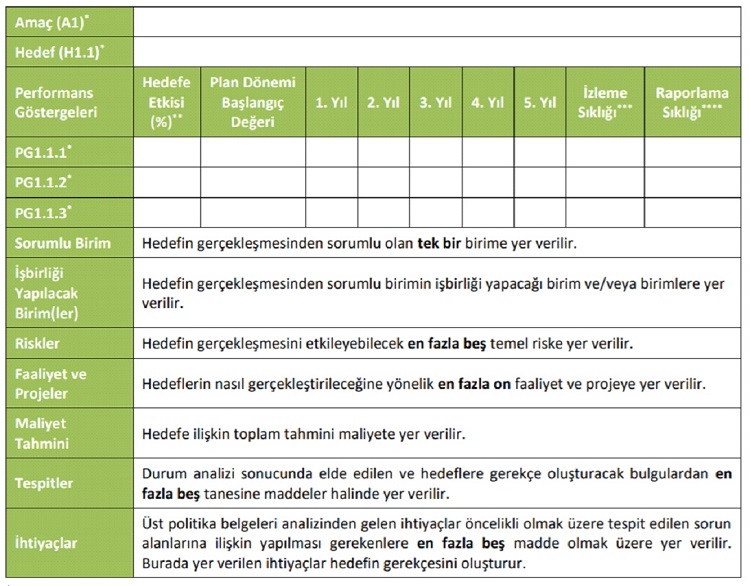
The guide particularly emphasises a strong link between analytical findings and the targets framework. Findings are consolidated in a “findings and needs” table: findings identify existing problems, while needs identify areas for institutional improvement. Another important change is the consolidation of information for each target into a single “target card”. Each card must present indicators, responsible and cooperating units, risks, activities and projects, cost estimates, findings and needs. To simplify presentation, the guide also limits the number of entries under these headings.
Source: Draft Strategic Planning Guide for Municipalities (2018), www.sp.gov.tr.
The guide also introduces a set of 85 municipal performance indicators to promote standardisation. Relevant indicators—such as the share of the population connected to the drinking and domestic water network, passengers carried per municipal bus, and bicycle lane length—may be used directly. Municipalities may also develop other indicators to measure their own targets.
Monitoring and evaluation receive greater emphasis. The guide clarifies these processes and defines responsibilities more explicitly than previous editions. Establishing monitoring systems, improving data infrastructure and strengthening reporting quality can therefore be expected to become more prominent on municipal management agendas.
Original supporting material (in Turkish).