Why Should Municipalities with Populations Below 50,000 Prepare Performance Programmes?
March 14, 2026
How local governments can deliver the services they are responsible for with the resources available is also a financial management issue. Grounded in the right to budgetary oversight, local budgets serve as a means of scrutinising how administrators exercise the authority delegated to them. Another important budget function is to guide administrators in prioritising services and identifying the future costs of decisions taken today. Fulfilling this planning and management role requires an effective performance programme that follows the strategic plan within a performance-based budgeting framework.
Local governments prepare performance programmes within the framework introduced by Law No. 5018, Article 32 of Municipal Law No. 5393, the Regulation on Performance Programmes to Be Prepared by Public Administrations published by the Ministry of Finance on 5 July 2008, and the Budget and Accounting Regulation. Exercising its authority under Article 9 of Law No. 5018, the Ministry also published the Performance Programme Preparation Guide in 2009 to standardise practice.
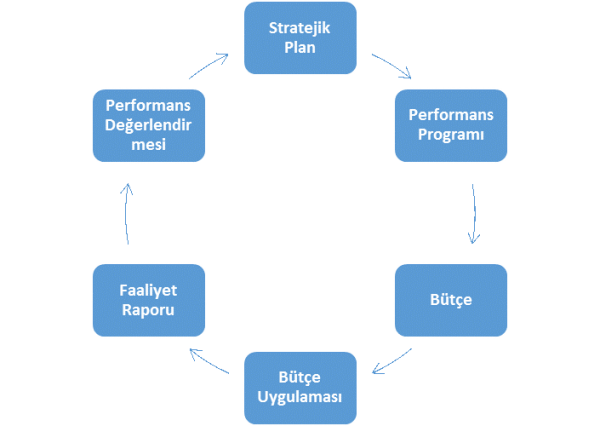
A performance programme links the strategic plan to the budget. It sets annual targets corresponding to the medium- and long-term objectives and targets in strategic plans, identifies the activities and projects required to achieve them, and specifies their resource needs. It also includes performance indicators for measuring, monitoring and evaluating the extent to which performance targets are achieved (Performance Programme Preparation Guide, 2009). While strategic plans primarily connect institutional priorities, objectives and targets with national, regional and other plans, performance programmes establish the link between planning and budgeting.
One issue debated in practice is whether municipalities that are not required to prepare strategic plans should nevertheless prepare performance programmes. Law No. 5018, Municipal Law No. 5393 and the Budget and Accounting Regulation point towards performance-based municipal budgeting. However, a 2009 amendment to Article 1(2) of the Regulation on Performance Programmes to Be Prepared by Public Administrations, published in Official Gazette No. 26927 on 5 July 2008, exempted administrations without a strategic planning obligation from preparing performance programmes. In our view, this exemption, absent from the original regulation, was introduced as a temporary response to limited technical capacity in municipalities with populations below 50,000 during a period of extensive transformation in public financial management and local government.
Over the eight years following the regulation’s publication, the capacity of these municipalities to prepare budgets aligned with performance programmes improved. Local government revenues also increased by 50% in real terms. Given their stronger technical capacity and substantial resource use, municipalities below 50,000—and at least those above 10,000 at this stage—should prepare performance programmes to use public resources effectively within a programme framework. In 2017, 347 municipalities had populations between 10,000 and 50,000.
Because existing budgets are not structured around activities and projects, budgets prepared without performance programmes largely become accounting formats. Standard tables under the analytical budget classification do not generate information by programme or subprogramme (objectives and targets). This distances budget discussions from policies and priorities. For the budget process and accountability envisaged in the relevant legislation to function, all municipalities should prepare performance programmes and submit them to their councils. The Ministry of the Interior and the Ministry of Finance should issue guidance in this area.
Original supporting illustration (in Turkish).